Friday, March 28, 2025

Confessions of an Automationeer, Part 199: Junior Sports Showdown

Confessions of an Automationeer, Part 199: Junior Sports Showdown

Now that QFC55 has finally concluded, I would like to tell you about how it went down - if you want a more detailed explanation about the backstory, rule set, and results, just click on the link above. As for my actual hosting experience, let's just say that it went down very well indeed - I got all the results out on time. And part from a minor mix-up regarding the deadline announcement (which I quickly rectified), there were no mishaps. But I received 27 entries (mainly due to how popular the rule set was with other users) this time, so I had to sort them into three groups of nine, as shown below.


Above, from top: The 27 entries I received in QFC55 were split into three groups of nine cars each - but I had to choose exactly one car from each of these groups to examine further in the final round of judging.

It did not take me long to pick a winner from each group after examining each entry's pros and cons. The top three therefore consisted of the Nanahoshi ReViZe, Zephorus Amida V6, and Tevian Tyros. The ReVize was the sportiest, thanks to a manual transmission, but also the most expensive, and trailed the other three finalists in drivability. The Amida was the best-looking and had the most powerful engine, but was also the heaviest, and its advanced automatic transmission compromised its sportiness score. That left the Tyros, which had the least powerful engine, but was the lightest, and struck the best balance between usability and excitement.


Above: The top three from each group gathered together for judging of the final round - from left to right, in the order I placed them.

The Tyros' substantially greater efficiency also helped it seal the win, especially considering that it was also the least reliable of the three (though not by much). And while it couldn't match the Amida for sheer drama, it wasn't a bad-looking car either.


Above, from top: The Tevian Tyros as submitted to me for QFC55, which it won. Other exterior colors are available, but this bright blue is my favorite.

And so I can proclaim that my latest attempt at hosting a QFC was a smashing success. The next post will be about something that's as crazy as it is unusual - so stay tuned for that one!

Wednesday, March 26, 2025

Confessions of an Automationeer, Part 198: Testing the Waters

 Confessions of an Automationeer, Part 198: Testing the Waters

In preparation for a forum challenge that I hosted, I decided to explore the possibilities within its planned rule set by creating some test mules, hoping to find. One of them, based on the 2011 Flyer mod body set (with a 2.3m wheelbase and a coupe body style), turned out to be the most promising of them all. This miniature mid-engined pocket rocket had a mid-mounted 1.6L I4 developing 200 horsepower, driving the rear wheels via a 6-speed manual gearbox and a helical limited-slip differential. Staggered 185mm/205mm high-performance tires wrapped around forged 16-inch alloy wheels easily put this power to the ground, while 280mm vented disc brakes with 1-piston calipers (justified due to the lack of mass they have to cope with - 960 kilograms is an absurdly light figure today) help it quickly come to a stop with no fade whatsoever. Finally, with a front lip, rear diffuser, and decklid spoiler to complement its aerodynamic undertray, it feels planted on the road even at the absolute limit.


Above: The emissions compatibility chart and chassis/suspension/body material options for my small mid-engined test mule based on the 2011 Flyer mod body set.

To lower the weight figure still further, I fitted a lightweight sports interior and a mid-grade infotainment system and safety suite, with variable electric power steering and a full set of driving aids (ABS + stability/traction control). With so little mass to keep in check, its suspension was tuned to provide a softer balance between sporty, agile handling and a comfortable ride, even with relatively simple progressive-rate steel springs, mono-tube dampers, and passive sway bars.


Above, from top: An overview of the QFC55 test mule's trim settings, tailored for a sporty driving experience without sacrificing too much comfort and safety.

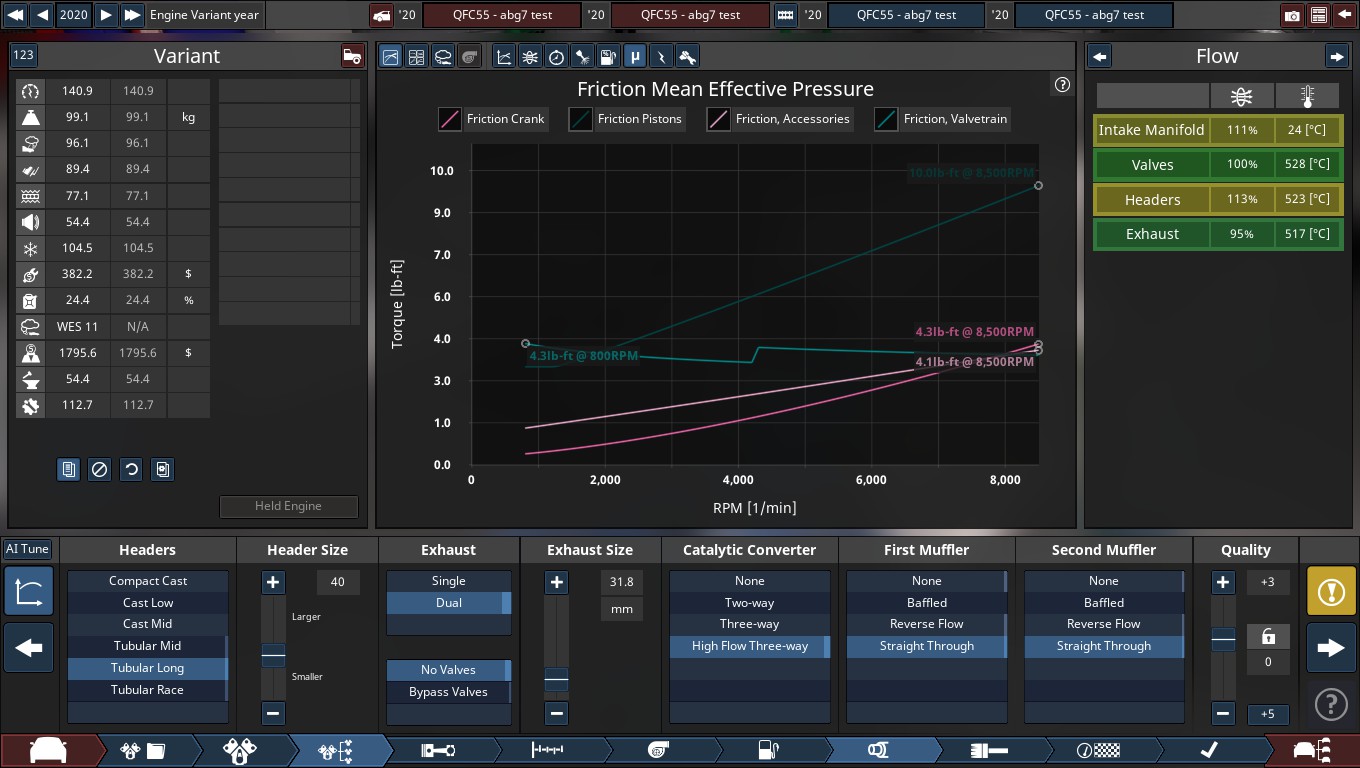
The engine develops much of its output in the upper rev range - an ideal trait for a performance car - thanks to a high-flow intake and exhaust headers optimized for higher RPM, enhanced further with a more aggressive secondary cam profile (due to variable valve timing and lift, allowing for a lower initial cam profile and hence a lower idle speed), individual throttle bodies, and lightweight forged internals within its closed-deck aluminum/silicon block and heads.


Above, from top: An overview of the engine used in my test mule - a small but light powerhouse with just enough output to have a lot of fun with.

All this adds up to a statistical surprise - in the best way. Its small size and relatively narrow tires give a boost to drivability, but the well-tuned suspension also plays its part; combined with the light weight and well-spaced gearing, this also leads to improved sportiness. However, my choice of body set  for this test mule compromised its comfort and safety scores somewhat, although it still managed to meet contemporary regulations in all markets.


Above, from top: A more detailed breakdown of the test mule's key stats and test track lap time, further explaining its surprising blend of user-friendliness, excitement, efficiency, and reliability.

Obviously, I wasn't expecting any of the actual challenge entries I received to even surpass the test mule in all (or at least most) key criteria, especially reliability, but I knew that it would do well enough statistically to at least be competitive. In the next post, I'll explain how the actual contest went down, and find out which one of the three came out on top, so stay tuned for that one.

Monday, March 24, 2025

Confessions of an Automationeer, Part 197: Toeing the Line

Confessions of an Automationeer, Part 197: Toeing the Line

Toe angle (the angle at which the wheels are aligned relative to a car's longitudinal axis) was only made adjustable in more recent UE4 builds of Automation, but since then it has become an integral part of configuring a car's suspension. In-game, it is represented by the amount of toe-in angle - thus, a toe-in setting of 0 degrees represents neutral toe, and any negative amount of toe-in represents toe-out. Here's how it works, as demonstrated by a test mule I'll take a deeper dive into in the next post.


Above: An example of a neutral handling setup, with a 50/50 balance between oversteer and understeer. It's not just the amount of tire stagger, weight distribution, camber angle, spring rates, and anti-roll bar stiffness that determines a car's handling balance - so what else could cause this?

The car in question is mid-engined, rear-wheel-drive, hence the 20mm tire stagger between the front and rear wheels. But this on its own is insufficient to compensate for its 43/57 front/rear weight distribution. The best way to combat the resulting oversteer (even with the amount of tire stagger used) is to increase the toe-in angle - in this case, to 0.25 degrees per axle.


Above: The greater the rearward bias of a car's weight distribution, the more toe-in angle will be required to counteract oversteer; conversely, if a car's weight distribution skews heavily towards the front, it will need more negative toe-in angle (i.e., toe-out) to reduce understeer.

There are some problems to be aware of, though. Depending on a car's weight distribution, having insufficient toe-in angle will lead to a (potentially terminal) oversteer bias, and using too much toe-in angle will lead to an understeer bias - both of them are undesirable (especially if the resulting bias is terminal), since they will result in reduced sportiness and drivability.


Above, from top: Too little toe-in angle will lead to an oversteer bias; too much will cause an understeer bias. In the latter two pictures, the bias has become terminal due to excessive toe-in/toe-out angle.

Hopefully this clears things up regarding how toe-in/toe-out angle works, as well as when and how much of it should be used.

Monday, March 17, 2025

Confessions of an Automationeer, Part 196: Small, Light, and Mild

Confessions of an Automationeer, Part 196: Small, Light, and Mild

In preparation for my most recent Automation Discourse challenge, I began defining what I considered to be a Small Light Passenger Car - a vehicle class that is subject to reduced taxation rates compared to others. To that end, I proposed several criteria in this category that emphasizes efficiency and affordability. They were as follows:
  • Maximum power output of 250 bhp.
  • Maximum engine displacement of 2500cc (any kind of forced induction imposes a 1.5x multiplier), with a maximum of 6 cylinders.
  • Maximum weight of 1500kg.
  • Maximum width of 1950mm, with a maximum length of 4400mm and maximum wheelbase of 2650mm. (I could've reduced the maximum width and wheelbase to 1900mm and 2600mm, respectively, if I wanted to).
  • Minimum fuel economy of 30 US mpg (combined). This accounts for the inherent lack of efficiency for normally aspirated engines compared to turbocharged equivalents (at least in the Ellisbury update).
  • Body style must not be an SUV/crossover or truck/ute; all other body styles are eligible. Convertibles will receive a minor stat bonus, however, but only during forum challenges.
  • No restrictions on seating capacity or drive type.
I implemented most of these restrictions for the actual challenge, with the exception of the width and length limits, since I wasn't sure if some body variants would be the right size. Otherwise, these were in line of what I wanted a small, light, and affordable passenger car to be - and prior to launching the challenge, I set the maximum price at $30,000, but raised it to $35,000 to allow for more freedom in engineering and design.

Before launching the challenge (and even several days after accepting submissions), I made a batch of test mules to see how viable its premise would be. Some of these showed more promise than others, but all of them confirmed my suspicion that too much power and weight would compromise performance (and drivability, if the car is large enough), while too much cost would limit its accessibility to the general public.

With the rules finally set, I decided to launch the Discourse challenge as planned. But the results are yet to be determined at the time of initial posting, so I'll leave the details on those until the next post.

Monday, March 10, 2025

Confessions of an Automationeer, Part 195: Two Icons Revisited

Confessions of an Automationeer, Part 195: Two Icons Revisited

When I finalized the specs for the 1995 LVC LS60 and its chief rival, the AMS Archangel, many months ago, I set the tech pool allocation for both of them at a total of $60 million per car; this figure represented the combined cost of engine and trim tech pool for each car. However, recent events have made me reconsider this decision, and so I decided on a 25% increase for the combined tech pool cost per car, to $75m. I then used the resulting extra headroom in the budget to invest in additional quality points throughout all trim areas, while remaining at or under my new self-imposed $100,000 AMU price cap. This ensured that both cars would have stats more befitting of a highly exclusive, ultra-low-volume hypercar of the era - one that customers would happily pay top dollar for.


Above, from top: After I reworked the 1995 LVC LS60 (blue) and its closest contemporary rival with 25% greater tech pool budgets for each, the AMS Archangel (red), both of them have performance and prestige that's even more commensurate of their enormous price tags.

While the LS60 now weighs exactly 1,000 kilograms (as I had originally planned), it also has an additional 25 horsepower to push it around (525 horsepower instead of 500), and needs just 3.6 seconds to reach 60 mph from a standstill (a 0.3 second improvement over the previous version of this build). That matches the Archangel's figure, even though that car has 50% more displacement and 150 more horsepower - albeit delivered sooner than before (7600 rpm, with a redline of 8000 rpm), and with 10% extra mass (1100 kg, which is still very light in absolute terms). But whereas the Archangel has more comfort and reliability, the LS60 counters with better drivability and sportiness, thanks to its smaller, lighter body. Other changes include increasing the downforce levels at both ends of each car to their maximum levels, and tweaking their suspension settings accordingly, along with further adjustments to their gear ratios.

In short, both the LVC LS60 and the AMS Archangel of 1995 have not had their appeal diminished one bit by the addition of tech pool and quality points - if anything, they are now even more tempting, to the point where they will draw the attention (and envy) of even the most jaded enthusiast.

Sunday, March 2, 2025

Confessions of an Automationeer, Part 194: Lighter and Saner?

Confessions of an Automationeer, Part 194: Lighter and Saner?


Having previously finalized the design and engineering of the 1995 HPG H2L, I decided to ask myself one question about it: "What if it had a smaller, lighter, and less powerful four-cylinder engine under its curving rear window?" To that end, I swapped its 2.0-liter flat-six for a 1.6-liter all-aluminum/silicon flat-four engine developing 200 horsepower at 8000 rpm (500 shy of redline), thanks to high-flow intake and exhaust manifolds and the magic of variable valve timing and lift. The resulting car was 45 kilograms lighter as a result, thanks to the fitment of smaller (and hence lighter) wheels, brakes, and tires. And while not quite as fast as it once was, 4.4 seconds to 60 mph from a standstill was quite impressive in 1995, especially considering the car's reduced power output. Best of all, it still handled and stopped just as well as it used to, if not better - the car's relatively low comfort level (an inevitable trade-off for making it so light and spartan) being one of its few drawbacks.


Above, from top: I originally wanted the HPG H2L to be powered by a six-cylinder engine, but have since realized that it may be far better off with just four - it's almost as fast, and crucially, handles and stops even better, thanks to being lighter than before. This time, the exhaust pipes exit from the center of the rear diffuser instead of the sides.

As before, the sound system can be omitted for even less weight, while semi-slick tires are optional for extreme track use - but even without them, this flat-four flyweight is still a legitimate giant-killer. In fact, I loved it so much (even more so than the original, in fact) that I decided to launch a whole challenge round themed around lightweight performance cars for the modern (2020+) era - although that will have to wait until a future post.

Wednesday, February 19, 2025

Confessions of an Automationeer, Part 193: Capstone of a Legacy

Confessions of an Automationeer, Part 193: Capstone of a Legacy


For my third and final submission in A Legendary Legacy, I decided to give the AMS Antares of the 2000s a once-over, using the same tech pool budget ($75m in total). This time, I spared no expense in making it perform as intended. With a billet block for its engine, plus a glued and extruded aluminum alloy chassis clad in aluminum bodywork, this was definitely a more expensive offering than its predecessor, especially when fitted with the optional carbon-ceramic brakes and 20-inch forged alloy wheels (as shown below).


Above, from top: The 2005 AMS Antares took its predecessors design cues and evolved them for the 21st century, but had all-new underpinnings beneath its muscular skin.

To justify the extra price, semi-active dampers were offered for the first time ever, and satellite navigation was part of the standard equipment list. However, it retained the Antares line's hallmarks of a naturally aspirated V8 driving the rear wheels, and a raised center section on the hood flanked by two functional vents, with one more on each front fender. And with 500 horsepower using the same displacement, thanks to variable valve timing and lift, the Antares' performance was even closer to true supercar status, if it wasn't already.

Semi-slick tires (not fitted to this example) were also part of the extensive option list, although they wouldn't be as suitable to wet-weather driving as the standard high-performance rubber. And as before, customers enjoyed a wide variety of interior and exterior color and trim options - they could even specify bespoke finishes at extra cost if they desired.

In short, this generation of Antares was a fitting exclamation point for this challenge trilogy to end on, with more than enough speed and handling to match the segment leaders, all wrapped up in a sensuous exterior that makes it an object of desire, even to this day.