Saturday, May 28, 2016

The Analysis of Infinite Space, Part 2d: Large Weapons

The Analysis of Infinite Space, Part 2d: Large Weapons


Apologies for the long delay between posts; I'd been on vacation in London the previous week pondering which direction this blog should take next, and much of this week assembling a pair of LEGO sets. But I am now back online and resuming my analysis of my Steam games.

When it comes to long-range combat, large weapons are usually your only option. These range from simple high-explosive missiles to exotic and highly advanced weapons. The cheaper ones, however, have at least one major drawback, and this limits their usefulness considerably. Thus, it is well worth the time, cost and effort to obtain what I consider to be the "elite" weapons of Sea of Stars, but I will start this discussion with the cheaper weapons and move on to the more expensive ones later. All of them have low fire rates, and such they should be combined with faster-firing weapons.


The Impaler Missile Rack, Fission Torpedo Pod and Fission Missile Rack are cheap and usually deliver plenty of damage for their price, but each of them has a major drawback, limiting their usefulness. The Fission Missile is slow-moving and vulnerable to point defense, the Fission Torpedo does not home in on anything, and the Impaler is rather weak compared to the other two. I therefore never use any of them in practice; the only time you would have to do so is when you are trying to win a custom-made battle scenario on a limited budget. And since the Fission Torpedo is not a standard item for any faction, you should stick with the other two in such circumstances.




The other four long-range weapons are powerful enough to be considered superweapons, and, apart from the Graviton Disintegrator, are the only such weapons worthy of this classification. One of these, the Multi-Missile Launcher, is the only such weapon guaranteed to be obtainable; it can be purchased at Haven Station (although it costs 575 credits), although if the Muktian Homeworld, Bandur, appears in the sector map, you can buy it there for 4 coins. You are not guaranteed to obtain the other three elite weapons; two of these can only be acquired by creating them with a Timeless Bauble.

The Multi-Missile Launcher and Cobalt Torpedo Tube have the longest range of all weapons in the game, but they cannot automatically target fighters, and the MML is further constrained by a minimum range, within which it becomes ineffective. However, a direct hit by an MML pod which has not released its clusters is very damaging - and unexpected, since the MML is seldom used this way. In addition, the Cobalt Torpedo Tube is a standard fitment on the Damocles, but that vessel only appears in the quest to destroy Primordius, so that weapon is seldom seen, whereas AI-controlled Muktian and Terran capital ships can carry at least one MML in the later stages of a game.

The Particle Vortex Cannon works differently from any other weapon in the game: it fires a sphere which does no damage on its own, but discharges a bolt of lightning at nearby targets, and these bolts are quite painful to anything they hit. Only one ship (the Tan Ru Decimator) carries it by default, and even then it can be countered by having your own PVC or, better still, sniping it with an MML, which has a longer range. An upside to the PVC's unique firing pattern is that it is the only heavy weapon which actually works against fighters. It is not the absolute best weapon you can obtain in the game, though.

Nova Cannons are regarded as the most effective weapon overall in the game, and rightly so, since despite having a shorter maximum range than a Multi-Missile Launcher, they travel faster, have the most damage per shot of any weapon available, and have a decent fire rate when allied to a high-end targeting system. They are only obtainable by activating a Timeless Bauble and creating the weapon by entering its exact name. It is a weapon to be feared; Yellow Kawangi Dreadnoughts have one of these mounted in their nosecones, but fortunately, no other vessel carries it by default. When you do get to use it, always exploit its immense firepower; a direct hit will destroy most ships instantly and cripple others.

In short, large weapons require the most effort to master. However, used carefully they can be incredibly useful against capital ships. When the enemy presence is high enough, sometimes they are your only means of winning a battle outright without sustaining casualties yourself. Choose with care and you will end up with properly terrifying space-going siege machines!

Sunday, May 8, 2016

The Analysis of Infinite Space, Part 2c: Medium Weapons

The Analysis of Infinite Space, Part 2c: Medium Weapons


Medium weapons are also a mainstay of Sea of Stars, and encompass a whole spectrum of weapons from short-range guns to long-range beam weapons. Prices vary greatly, from just 150 credits for a Micro-Meteorite Gun to 506 credits for a Graviton Disintegrator. There are 10 weapons of this size class, each with their own pros and cons, but all can only be mounted on capital ships with at least one medium-sized turret. I will now give a detailed description of each of them.


The Micro-Meteorite Gun has the shortest range of all medium weapons, but is surprisingly useful. Its spray of shrapnel, though inaccurate at range, is devastating up close, just like a shotgun. Given that it is standard equipment on Tan Ru Inspectors and Demolishers, you should attack them at range to avoid being blasted by debris. In fact, combining this weapon with a Plasma Blaster will make a capital ship extremely effective in close-range combat.


Gauss Cannons, like Neptunium Railguns and Mass Drivers, are magnetically powered, but spit out a large projectile every few seconds instead of several small shells every second. This weapon is commonly used throughout the game, particularly by Terran, Muktian and Zorg capital ships. It is also standard equipment on Tan Ru Dominators. While it's a good all-round weapon, it doesn't stand out in any area either, but it's still a great affordable medium-range gun for most situations, although the slow muzzle velocity makes it less useful against fighters.


The Gatling Laser is basically a cluster of laser beams revolving about a common central tube, and is even more powerful than the standard Laser Beam or Repeater. Its high fire rate compensates for its mediocre damage per shot and short range. This weapon can wear down light shields far more quickly than even a Neptunium Railgun or a Cone cannon. There are better close-range weapons available, though, but this one is far more affordable.


The Strange Quark Projector and Proton Phasor Beam are also short-range beam weapons, but sacrifice fire rate for more damage per shot. While it may be tempting to use a Phasor, especially since the Klakar utilize it, its slow fire rate can be a hindrance at times, although against most capital ships it can be quite useful. The quark beam is a better bet, though, due to its superior fire rate. It helps that although the Urluquai mount them on Deep Hunters and Carriers, you can buy these weapons as well and, if you have a cloaking device, use their own tactics against them.


The Plasma Cannon is the Calatian counterpart to the Gauss Cannon, and is standard on Calatian Dreadnoughts and Super Dreadnoughts. It's basically a Plasma Blaster scaled up to the size of a Gauss Cannon, but with emphasis on damage per shot and range. In fact its price and stats are basically identical to that weapon. Thus, they both have the same strengths and weaknesses.


The Antichronon Pulse Blaster and Positron Scrambler Beam are antimatter-based hitscan weapons. Both cost 253 credits each, but the positron beam delivers more damage per shot. The antichronon beam is standard equipment on Zorg capital ships, however, and can be bought from their homeworld. The slow fire rate makes them most useful as medium-range siege weapons, but they are equally effective against all ship types, particularly when allied to a targeting computer of some sort.


Now this is a real must-have medium-sized weapon! The Tachyon Ray Gun, if you can obtain it, is one of the best general-purpose weapons in the whole game. It's more potent than most other medium weapons and has a better fire rate than other beam weapons. The long range makes it ideal for chewing up whole flotillas when combined with other high-end weapons. In fact it is possible, though rare, to acquire two or more of them in the same game. There is, however, one medium weapon which is even deadlier, but good luck acquiring it...


Only one medium-sized weapon is more powerful than a Tachyon Ray Gun. The Graviton Disintegrator is the most terrifying beam weapon of them all. Its bright yellow beam has a shorter range than the purple one emitted by the TRG, but it is much more powerful and fires faster. It's only used by the Yellow Kawangi (whose dreadnoughts carry four such weapons, making anything other than long-range sniping practically suicidal), and thus the only way to obtain one in the campaign is to create it using a Timeless Bauble (although you can use it freely in the Combat Simulator). When you get your hands on one of these nasty things, however, you will obliterate entire fleets in no time at all.

In short, medium weapons make a nice complement to other types of weapons, depending on what your strategy is based on. However, you may also need a targeting computer to really make it work. Choose carefully and your flotilla will be feared by every foe you encounter throughout Sector Prime!

Saturday, April 30, 2016

The Analysis of Infinite Space, Part 2b: Small Weapons

The Analysis of Infinite Space, Part 2b: Small Weapons


Small weapons are the bread and butter of Infinite Space III: Sea of Stars. They are generally cheap and fit on almost any turret on any ship. Most of them do only a small amount of damage, but all of them have at least one redeeming feature. Some can even be used as point-defense weapons for shooting down incoming missiles. I will now give a summary of each weapon and rate their overall effectiveness.


The Explosive Shell Chaingun is a very basic weapon, with a short range and very low damage per shot. However, its fire rate is very high, making it effective against fighters and lightly shielded capital ships. For this reason, it should not be underestimated, particularly when several of them are brought to bear on your fleet. This also explains why a Garthan flotilla is always nasty at close range - their ships can tear you apart if you get too close to them.


Neptunium Railguns are standard equipment on your starting ship, along with the entire Terran fleet for most of the game. Its fire rate is slower than the chaingun but each shot delivers considerably more damage. Despite a similarly short range, this weapon is far more useful than the chaingun due to its point-defense capabilities. It definitely makes you think twice about attacking a Terran flotilla with missiles.


The Laser Beam and Laser Repeater are not as effective as the previously described weapons because despite being beam weapons, each beam delivers a small amount of damage, even less than the railgun. However, a large number of them can be painful. This makes Tan Ru Drones and Demolishers much more dangerous in large groups. Nevertheless, they are ineffective against anything with stronger shielding than an Electron Matrix Shield.


Molybdenum Cone Cannons can also be used for point defense, but are more expensive. However, this is justified by their greater damage per shot. They are the standard-issue short-range weapons of the Muktians and can be even more painful in large groups than a similar number of Neptunium Railguns. It will take a lot of shots for individual cannons to do any real damage, but the high fire rate is a mitigating factor.


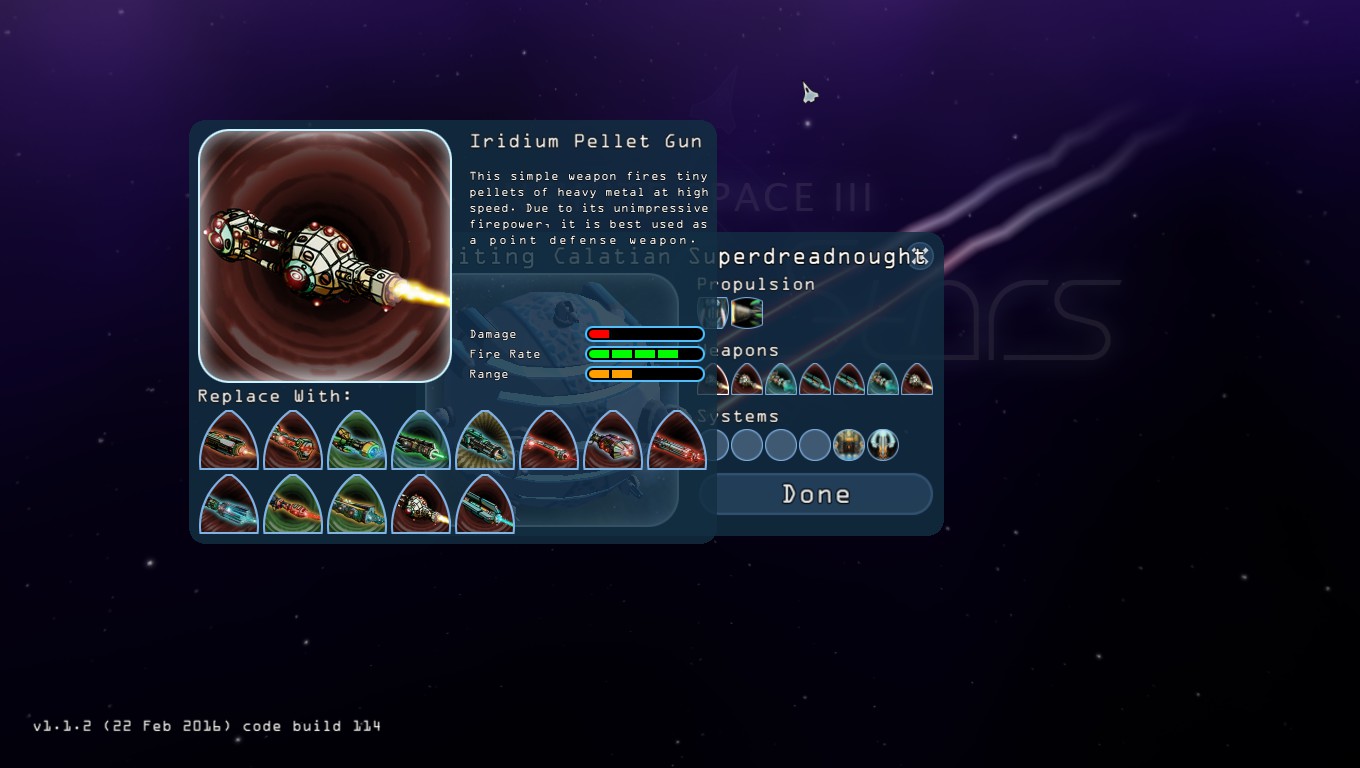
The Calatians use the Iridium Pellet Gun and the Electric Bolt Gun for short-range combat. They are essentially cheaper versions of the Plasma Blaster and Neptunium Railgun respectively. Pellet guns are too weak to be used for anything other than point defense and should be swapped out for superior weaponry as soon as possible. Electric bolt guns are more powerful, but are still very tame compared to a Neptunium Railgun.


The Electron Accelerator Beam is the standard short-range Urluquai fighter weapon. Its fairly high damage per shot is offset by a slow fire rate. However, all Urluquai vessels carry advanced targeting computers, which negates this drawback to some extent. In fact, a large number of Urluquai fighters can be deadly against most foes, including you unless your tactics and weaponry are up to the task. Still, it is less useful for human players since there are better weapons available for similar money.


Mass Drivers are like miniature shotguns, as implied by their description. They are more expensive than Micrometeorite Guns but have a longer range and a faster fire rate, although their damage per shot is even less than an MMG's. The rapid-fire capability and surprisingly long range makes a close-up shootout with a Tan Ru Fabricator (those large, boxy ships which spew out drones eight at a time from the front) positively suicidal. 


Now we're talking! These last four weapons are the best of their kind, and are well worth obtaining by any means. The Gluon Gun, Fusion Rocket Launcher, Plasma Blaster and Proton Blaster are the most effective weapons when you're faced with a swarm of fighters coming at you. Gluon Guns have the lowest damage per shot of the four but compensate for this with a fast fire rate and a longer range than similar weapons. Still, they are more expensive than Plasma Blasters and Fusion Rocket Launchers, both of which are preferable when you reach the point at which more firepower is necessary.

Fusion Rocket Launchers are available immediately to the Urluquai and Calatians, although the Terrans will not utilize them until the midpoint of the game. These are good all-around weapons, with decent damage per shot, fire rate and range. Although the missiles they fire can be shot down by point-defense weapons, one can negate this drawback by installing several of them on the same ship. In fact, it is a good idea to retrofit the Thunderbucket (the Calatian capital ship which joins your flotilla upon delivering the Calatian Castaways to their home system) with these, since its all-around weapons coverage makes it potentially one of the best ships in your flotilla.

Plasma and Proton Blasters are fielded by the Zorg and Terrans, although only the former use either of these weapons from the start. The Zorg will also use Proton Blasters much sooner than the Terrans. Proton Blasters are basically heavily upgraded Plasma Blasters, with more damage, a faster fire rate, and much longer range, as well as point-defense capabilities. They are also far more accurate and are distinguishable by a short green beam fired from a small tube, compared to the Plasma Blaster's heavy barrel, which fires blue teardrop-shaped bolts. However, they also cost more to purchase at Haven Station, which orbits the Terran homeworld of Hope. Buying them for their superior firepower, accuracy, and range is still worthwhile, though; a Calatian Destroyer or Cruiser armed exclusively with these, and equipped with high-end shields, targeting computers and thrusters, will make mincemeat of all but the toughest boss flotillas (Kawangi, Primordius) in seconds on its own.

In short, small weapons may seem puny at first due to their limited range, but can be extremely effective when used correctly. Some also deliver plenty of damage per shot, have a high fire rate, can fire farther, or a combination of all three to justify their extra cost. The cheaper ones can even serve as trade fodder for more expensive items. Your flotilla should ever be without at least one of these unless you have a very good reason. But once you've mastered the small weapons, you'll want to arm your ship with bigger guns...

Saturday, April 23, 2016

The Analysis of Infinite Space, Part 2a: Introduction to Weapons

The Analysis of Infinite Space, Part 2a: Introduction to Weapons

There are 30 different playable (in the sense that they can be used during normal gameplay) weapons in Infinite Space III: Sea of Stars, and some are obviously better than others. These weapons are classified according to size and how they work. In addition, some weapons may be purchased from homeworlds (since they are standard equipment for whoever controls them). Before I discuss each weapon in depth, I will give a brief description of each attribute and how it affects its effectiveness.


From top to bottom: examples of a missile weapon, a projectile weapon and a beam weapon

Weapons in Sea of Stars fire projectiles, beams, or missiles. Projectile weapons fire a round of ammo at short intervals, and in addition to being smaller on average, tend to have high fire rates, except for larger ones, making them ideal for taking down fighters (as well as being capable of point defense in some cases). Beam weapons emit a continuous beam every few seconds; they are bulkier than projectile weapons but deal more damage per shot and have longer ranges, although they tend to have slower fire rates. While not as effective against fighters without a targeting system, their increased damage and range makes them more useful against capital ships. Missile weapons launch a homing or unguided missile at regular intervals. Most of these do not automatically target fighters, and the ones that can are best reserved for use against capital ships, since they are unguided.


Above, from top to bottom: Examples of large, medium and small weapons

Weapons can also be classified according to size. Small weapons can be mounted on any regular ship; of the 13 weapons in this size class, only one (the Fusion Rocket Launcher) is missile-based and just three (the Electron Accelerator Beam, Laser Beam and Laser Repeater) are beam weapons, while the remainder fire some sort of projectile. Medium weapons can be placed on anything but the smaller Calatian ships; most of these 10 weapons emit a continuous beam, while a few launch projectiles, but none of these weapons fire missiles. Large weapons cannot be mounted on any Calatian vessel and are almost exclusively missile-based, except for the projectile-spewing Particle Vortex Cannon; this is the smallest category, with just seven weapons in total.

The most important attributes for weapons, however, are damage, fire rate and range. Damage per shot determines how many points are taken off a target's shields or hull with each hit. Fire rate is inversely proportional to the amount of time taken between shots. Range is the farthest distance at which a weapon can fire at enemy ships. Ideally, a ship should carry at least one fast-firing short- or medium-range weapon for anti-fighter use, and, if possible, some slow-firing, long-range, high-damage weapons for attacking capital ships from afar. You will find out why you need this combination in the next post.

Tuesday, April 12, 2016

The Analysis of Infinite Space, Part 1: Ship Size

The Analysis of Infinite Space, Part 1: Ship Size


Apologies for the long delay between posts, but I was struggling to determine the next topic after discussing the quests. I finally decided to do combat analysis for the next few weeks, given that this has not been touched upon by anyone else as far as I am aware. My first post regarding this topic will discuss ship size, which is a key factor in determining a ship's combat effectiveness. Before we delve into further discussion of this parameter, you should know that this only applies to capital ships; all fighters are basically the same size and hence move at roughly the same speed.

Speaking of which, speed is a key factor affected by ship size, since smaller capital ships (corvettes and scouts) generally move faster than bigger ones (frigates and destroyers), assuming they are equipped with the same thrusters. In addition, larger ships also tend to be less maneuverable than smaller ones, again with the assumption that the same type of thruster is used. The following two screenshots illustrate this perfectly.


"This ship is fast, sleek and deadly, with maneuverability to match..."


"...but on the other hand, that thing, though slower and less agile, carries more guns and armor."

The upper picture shows a fully upgraded Terran Corvette, while the lower picture shows a Terran Advanced Destroyer. The destroyer is much larger than the corvette and hence can't turn or move as quickly. However, large capital ships compensate for this by having more armor, turrets, and equipment slots. For example, the corvette has two turrets and can utilize five pieces of equipment, while the destroyer has four turrets (five in the Advanced variant seen here) and, like the smaller Frigate, six equipment slots. Some ships, however, defy the usual rules about size affecting speed and maneuverability.


"How can a ship this big move so fast?"


"This thing is so small, it moves like greased lightning!"

The most notable exceptions are Garthan capital ships. These vessels have a much higher combat speed due to their lower mass, but on the other hand, they are less maneuverable than other races' ships. Calatian capital ships are the smallest of all compared to equivalents from other races, and are thus the fastest and most maneuverable in their respective classes. Thus, a Garthan Frigate can bludgeon its way through the battlefield as quickly as a Calatian Destroyer can scoot about the map. In contrast, Muktian vessels, with their thicker armor, tend to move slower and have less space for equipment than other ships.

An additional consideration when deciding whether or not to trade up to a larger capital ship is the base value of the vessel. Smaller ships will yield a lower score at the end of the game, although they cost less to purchase; on the other hand, larger ships require more credits (or coins, for non-Terran ships) to buy but will increase your score upon retirement, particularly when fully equipped with weapons and systems. However, trading in existing ships for larger ones may not even be possible under certain circumstances where you have relatively few credits. Moreover, a larger vessel will move faster through empty space than a smaller one with the same star drive, so be sure to put the best star drives in your largest vessels.

One final note is that you must consider where continuing to use at least some of your current capital ships contradicts your strategy. If it does, trade up to larger vessels as soon as you can, particularly on higher difficulties where you will encounter stronger enemy fleets. So do you want a slow, lumbering behemoth of a ship, or something smaller, nimbler and faster? It's all up to you to decide, and if you choose wisely, you will have no trouble conquering Sector Prime.

Friday, April 1, 2016

The Quests of Infinite Space, Part 5: Swamp Pirate Rebellion

The Quests of Infinite Space, Part 5: Swamp Pirate Rebellion


"A splinter faction... How treacherous!"

The Swamp Pirate Rebellion is the fifth and last quest in Infinite Space III: Sea of Stars and was added in version 1.1.0. It is especially noteworthy because this quest is the only appearance of a ship from another game - specifically, the Kestrel, the default ship in FTL: Faster Than Light. Even the objective pays tribute to the premise of Faster Than Light: collect the Kestrel, destroy the pirates attacking Glory before they obliterate the whole system, and eliminate the remaining pirate presence in the sector. Here's how you can purge Sector Prime of these reckless renegades.


"We may never have seen it before, but doesn't it remind us of our ship?"

The quest begins when you discover the Kestrel abandoned in orbit around a faraway star system. This ship will never fire on you as you approach it (unlike the Derelict Vessel, which may do so if the ship attempting to board it is uncloaked), and so you can board it immediately. You will then have the Kestrel in your flotilla, and it's quite a formidable ship, with four turrets and six equipment slots, although initially, you will seldom have the equipment (or the money to buy it, in coins or credits) to make it really effective.


"It's nice to have the heavy artillery on our side for a change!"

Acquiring the Kestrel will begin the second part of the quest. In it, Arch Fenster's Swamp Pirates will occupy Glory and destroy the whole system in two years unless you destroy them. Before this, he will send his other two pirate fleets towards Glory, making it tougher to liberate the system the longer it takes for you to get there. You must destroy every pirate fleet in the sector, but don't actually need the Kestrel to do so. Here's how. 


"Those vile scum deserve to be obliterated after what they've just done!"

Combat against the pirates is similar to a battle with the Urluquai, since the pirates employ similar ambush tactics. However, pirate ships can't cloak or spawn a half-dozen fighters at a time, and the Pirates have more advanced weaponry than the Terrans usually do. Specifically, all of their ships carry a Micro-Meteorite Gun, while Pirate Corvettes also come with a Fusion Rocket Launcher. Pirate Frigates add a Plasma Cannon to the mix, and Pirate Destroyers are equipped with all of the above plus a Proton Blaster, the best projectile weapon in the game.


"We have no choice but to get rid of Arch Fenster and his henchmen!"

You are guaranteed to engage at least one pirate fleet at Glory, and like the Ravian swarm and Urluquai crusaders, the pirate fleet varies in strength depending on the difficulty. At the very least, the smallest fleet consists of a corvette and two scouts; another fleet is comprised of a frigate and two scouts, and the third - Arch Fenster's fleet - has a destroyer in it along with two more scouts. Of course, this last fleet is the toughest one to take down since the destroyer has room for all four pirate weapons. 


However, at Glory, you will receive assistance from fighters launched from Haven Station, and sometimes at least one Terran capital ship as well; the fighters will harass the pirate capital ships (they don't use fighters, strangely enough) until they or their targets are eliminated. Haven Station will also spawn four fighters once all existing ones are destroyed, but if the pirates manage to blow up the whole station, it's basically curtains for the Terrans. Thus, always take out the reinforcements as soon as they spawn, since they will target the station first; you can prevent this by stationing your flotilla near the station. The reinforcements won't show up unless the battle is going badly for the pirates, though, so you can hang back and snipe the pirates using assorted long-range weapons until that happens (or, if you have a cloaked ship, position it in the pirates' blind spot and ambush them from there).


"Now that the blockade's gone, we'll smash the rest of the pirates!"

Once you take out all pirate fleets in Glory, you must destroy every other such flotilla in Sector Prime to complete the quest. Of course, if all three fleets reach Glory and you manage to wipe them out all at once, this becomes moot since the quest will end as a result. Defeating a pirate fleet at an unoccupied system is tougher since you are usually on your own, particularly on higher difficulties. It's even more satisfying, though, and well worth the effort.


"Well, that's it for the pirates. They won't threaten us ever again!"

Although this quest does not award you with 5000 credits after completing it, you will still gain plenty of points for destroying all of the pirate fleets, and receive the achievement "Flight of the Kestrel" the first time you do so. It should be noted that erasing the Kestrel from existence using a Limited Vacuum Collapser produces mixed results. Doing so after finding the ship will cause the quest to end in failure (since you must recover the ship after discovering it), but detonating the device before sighting the Kestrel will prevent the quest from even starting, which the game treats as if you actually triggered the quest in the first place and subsequently completed it. Now stand up for justice and send those vile pirates to their maker!